Showing posts with label cosmology. Show all posts

Main Index

Written by Ed Babinski in the *mid-latter 1990s, this series provides scientific inquiry on a number of themes related to the Creation vs. Evolution debate, including Geocentrism, Heliocentrism and the Biblical Flat Earth, Human and Animal Evolution. Including some pithy and insightful criticism of Darwin's critics. *Originally for Talk Origins

Cretinism or Evilution?

Number 1, Winter-Spring 1995

Cretinism or Evilution?

Number 2, Summer 1995

    • Forget about the "evils of Darwinism", some creationists say the initial blame lies with the "evils of Copernicanism!"
    • Henry Morris on the existence of other planets circling distant stars
    • Is the Earth the "Center of God's interest" with the rest of the cosmos providing various essential services for the earth and its inhabitants?
    • Parallels between creationists and geocentrists
    • From abandoning geocentrism to accepting evolution: a "liberal trend" among evangelical christians?

Cretinism or Evilution?

Number 3, Winter/Spring 1996

Creationist Tall Tales!

    • A Ninety-Foot Tall Plum Tree! - (Bearing green leaves and fruit found frozen on an island hundreds of miles north of the arctic circle!)
    • Further quotations from Darwin on "Design"
    • Darwinism: Reports of its death have been greatly exaggerated

"Social Darwinism"

Also of interest is the statement in the press release for the Dictionary of Darwinism and of Evolution: "To combat the endless distortions of Darwin's ideas, an international team of 150 specialists in the biological sciences and human studies has, over a period of 10 years, achieved an historical and critical synthesis of Darwinism and evolutionary theory. At last the matter has been clarified: Darwin is not the father of modern anti-egalitarian theories; Darwin is the founder neither of negative eugenics nor of dogmas of the elimination of the weak; Darwin is not the justifier of Victorian imperialism, in short, Darwin is not responsible for Social Darwinism.'"

Likewise, Peter J. Bowler (of Queen's University, Belfast) in his recent book, Darwinism (Twayne, 1993), discusses the uses of the concept "Social Darwinism" and shows how such uses are often illogical extensions of the theory of evolution and natural selection. Another lesson for creationists to ponder.

E.T. BABINSKI

Cretinism or Evilution?

Number 4 and 5

Summer/Fall 1996, Winter/Spring 1997


Why We Believe in a Designer!

    • E. T. Babinski's "Cretinism or Evilution" speech at Dragon-Con in Atlanta, June 1996; or, "There is no joy in Eden, for creationism has struck out"
    • The most provocative things ever said about the way God "designed" the cosmos
    • Natural selections from Uncle Ed's holy book

"A preacher thundering from his pulpit about the uniqueness of human beings with their God-given souls would not like to realize that his very gestures, the hairs that rose on his neck, the deepened tones of his outraged voice, and the perspiration that probably ran down his skin under clerical vestments are all manifestations of anger in mammals. If he was sneering at Darwin a bit (one does not need a mirror to know that one sneers), did he remember uncomfortably that a sneer is derived from an animal's lifting its lip to remind an enemy of its fangs? Even while he was denying the principle of evolution, how could a vehement man doubt such intimate evidence?"

SALLY CARRIGHAR, WILD HERITAGE

"1996 presidential contender, Pat Buchanan, said something along the lines of `You may believe that you're descended from monkeys, but I believe you're a creature of God.' I guess that Buchanan hadn't considered that one of the basic tenets of Christianity is that God is the Creator of everything, including `monkeys.' It seems to me that one of the basic reasons behind the so-called `creationism' is the feeling that somehow parts of God's creation are not worthy of being our ancestors."

TOM SCHARLE (scharle.1@nd.edu)

Creationist Folk Science

Creationist Folk Science

The Evangelical Christian professors at Calvin college who wrote Portraits of Creation (Eerdmans Pub. Co., 1990) argued in that book that young-earth "creation science" was "folk science." I'd like to add that the "creation evangelists" with the most attention-grabbing presentations specialize in repeating "tall tales" -- tales that their more astute creationist brethren abhor, because, after all, not even all creationists are created alike, some keep evolving. With every retraction of an outrageous claim, they dig up a new one equally as outrageous as the first, and this new one is asserted with the same absolute assurance as the prior claim, and with just as little evidence to back it up.

Evolutionists have made assertions based on insufficient evidence and made claims which have been proven false, like the "Piltdown man" skull (which turned out to be a hoax), and the postulated existence of "Nebraska man" based on the evidence of a single tooth that turned out to belong to an extinct species of pig (though many scientists questioned the "human" identification right from the start, and it was a British newspaper artist, not a scientist, who made the drawing of "Nebraska man with his family" to sell papers). And there's Ernst Haeckel and Thomas Huxley's claim that some curious looking mud from the sea bottom might represent the "first life" on earth, and hence they named the mud Bathybius Haeckelii, but the mud was in reality, lifeless, and failed to grow. (However, bacteria have recently been found growing near the ocean floor near some steaming hot sea water vents, and some evolutionists have postulated - with better reason than before - that perhaps the first living organisms arose "on the ocean's floor," rather than near the earth's surface.)

The difference between overly zealous evolutionists and the less astute creationists in this area, however, pertains to who disproved the original flimsy assertions and how. In the case of claims made by evolutionists, it was fellow pr-o-evolution scientists, not "creation scientists," who dug deeper and conducted the disproofs via critical scientific investigation of the original assertions. Even today, evolutionists are so candid in revealing the nature of their finds and also admitting difficulties when it comes to fitting some evidence squarely in place, that creationists comb scientific literature just to pick out such difficulties. There is no "conspiracy" among evolutionary scientists who speak and write as candidly as they do. - But among the less astute creation scientists there is a vain repetition of outmoded claims that goes on and on, hence the term "folk science" when applied to creationism.

Furthermore, concerning "creation science" assertions, it's the mainstream scientists, again, who point out the flaws in the creationist claims, since the majority of creationists (and their supporters) are so reluctant and/or inexperienced in digging up further relevant information regarding the claims they assert. Often one need only check the original records of mainstream scientists to see where the creationists misread the original findings! Which just goes to show that creationist claims are often totally vacuous, either hearsay, or a misquoted or misunderstood passage from a mainstream science journal. I've mentioned several such cases in the Fall insert alluded to above ("The Earth is Old! According to evangelical Christians!"), and I have more such retractions on file. But, to repeat a few: Creationist and engineer, Walter Brown, had to be instructed by some biology professors as to what "adding a leap second" on the atomic clock really referred to. (It did not mean that the earth's speed of rotation was "slowing down a second per year.") Or take Henry Morris' claim in The Genesis Flood, regarding perhaps the world's largest case of "out of sequence" geological layers, the older layers lying atop the younger ones, and how he emphasized that this disproved modern geology, when in fact, it proved that even immense overthrust faulting (in this case, the Lewis Overthrust) could occur, and that modern geology is correct in its determination of the relative order of geologic strata and geologic ages. Even the geologist (Steve Austin) and paleontologist (Kurt Wise) both affiliated with Morris' Institute for Creation Research, have admitted that in this famous case an overthrust was indicated by the geologic evidence, and in effect, Morris was misinterpreting the original data at his disposal! Morris has also backed down concerning his claim that "human footprints" had been found along with dinosaur footprints in Texas. Most astute young-earth creationists have likewise backed down from their previous assertions concerning these "human footprints." These depressions and markings only superficially resemble human footprints, and the original creationists who asserted that these footprints were "human," simply blinded themselves to evidence of the dinosaurian side toes, evidence which can be seen even on the earliest film, "Footprints in Stone." The other evidence of "man prints" in Texas consisted of obvious carvings of human footprints, carvings which even some young-earth creationists (like those at Loma Linda) rejected right from the start. Again, in this case, the less astute creationists were eventually shown the errors of their superficial "researches" by mainstream scientific researchers who made detailed maps of the so-called "footprints" and 'human trails" (far more detailed than the "creation scientists" had made, and took photos over a period of years, and compared dino tracks elsewhere, which clearly demonstrated the dinosaurian nature of such trails, and how the prints were formed). There are too many cases of creationists "backing-down-once-cornered-by-mainstream-scientists" for me to even mention them all in one brief article. And that's because there have been far too many wild assertions made by creationists over the years.

Of course the less astute creationists are loathe to admit that even one of the "classic" creationist "tall tales" can ever be "disproven." Creationists like Carl Baugh, who wants to build a museum shaped like Noah's Ark near the site of the Texas "mantracks," seems to have never admitted making a single erroneous assertion or interpretation, though he's changed his tune a couple times, like when he admitted that the "giant mantrack trails" pointed out by earlier creationists were indeed only dino-prints. But then he proceeded to convince himself and some others that, although the prints in the trail were made by dinosaurs, he could make out smaller "human prints" "inside" each dino-print!

Whereas before, he could make out "human toe depressions" along the outer edges of the dino-prints' now he could - make out "human toe depressions" inside the same dino--prints, the human having 'walked inside" each dino-print the animal left as it passed.

Or take the case of Baugh's discovery of a "fossil human tooth," which he eventually allowed some scientific experts to examine under an electron microscope, and which was found to be merely a fossil fish tooth. Baugh conceded it was a fish tooth, but later retracted his concession. Baugh also found some rounded inorganic rock concretions and claimed they were the "fossilized skulls" of modern mammal species found among dinosaur remains!

Baugh is one of those fellows who is able to see and find exactly what he wants to see and find. He never lets evidence, especially contrary evidence, get in the way of his theories. Baugh's ability to find what he wants to find is only exceeded by Ron Wyatt's, another creationist, who has asserted that he has found: 1) the remains of Noah's ark, 2) the Ark of the covenant (I thought only Indiana Jones ever found that!), 3) The true site of the Israelite's Red Sea crossing, 4) Chariot wheels from Pharaoh's drowned army, 5) The actual rock Moses struck to release water for the Israelites in the desert, 6) The true site of the crucifixion, 7) Noah's grave, 8) Noah's house, and, 9) Mrs. Noah's grave.

Folks like Baugh and Wyatt lie at the least astute and most gullible end of the spectrum of "creation folk science," much like "Saint" Helena (the mother of the first Roman Christian Emperor -- Constantine) did. Helena lived about four hundred years after Jesus' day. "Way back then, Helena traveled all over Palestine and was always fortunate. Whenever [she] found a thing mentioned in her Bible, Old or New Testament, she would go and search for that thing and never stop until she found it. If it was Adam, she would find Adam's grave; if it was the Ark of Noah, she would find the Ark; if it was Goliath or Joshua, she would find their graves." [Mark Twain in The Innocents Abroad] "Saint" Helena found the copper plate that Pilate had nailed to the top of her Savior's cross, and upon which Pilate had written, "This is the King of the Jews." She also found the three crosses upon which Christ and the two thieves were crucified, and the exact spot of the crucifixion, and the very spot where the soldiers divided the rainment of the Saviour, not to mention the tomb of Melchizadek (a very obscure Old Testament prophet), and the rift in the rock made by the earthquake (mentioned only in Matthew) at the time of Jesus' Crucifixion. Helena was as fortunate as a Ron Wyatt and a Carl Baugh rolled into one! But it's easy to "find" everything you're looking for if you just use "eyes of faith.." For faith is a wondrous thing. It can move mountains and also convince you that a herring is a race horse.

A Critique of Geocentricity, Review by Francis Graham

A Critique of Geocentricity, Review by Francis Graham

Geocentricity by Gerardus Bouw, Association of Biblical Astronomy, Cleveland: 1992.

Bouw's Geocentricity is the latest in a series of books seeking to re-establish geocentrism as a religious doctrine alongside "Scientific Creationism" and with much the same tactics. Previous works included Bouw's earlier With Every Wind of Doctrine (1984), Walter Van Der Kamp's De Labor Solis (1989), and Marshall Hall's The Earth is Not Having (1991). Bouw, unlike the other authors, has a genuine astronomy Ph.D. from Case-Western Reserve University .

His book first recalls Biblical passages whose literal reading favors geocentricity, and unlike his earlier book, we are not showered with a barrage of vague passages, but he rests his case firmly on several very good ones, exploring other interpretations which try to save Biblical inerrancy while allowing a mobile Earth. In this he is better than his earlier work, and Bouw must be given credit: he provides a strong case that if the Bible is absolutely literally inerrant and devoid of poetic form, cultural content and phenomenological language, then indeed the Earth is immobile. Unfortunately, he also has to use the same type of arguments he argues against when he deals with additional problem of the Bible speaking of a flat Earth with corners. He strains to argue that the "corners" refer to capes, such as Cape Horn, "corner" coming from the root, "cornu", meaning "horn". He ends up resorting to a scientific proof, namely, that the shadow of the Earth on the moon is a section of a circle when the sun is shining from any direction, and that, therefore, the Earth is necessarily a sphere. Although he later rebukes Aristotle as being an example of "the utter bankruptcy of Greek philosophy" (p.174) he has no trouble using this argument from Aristotle carefully unattributed.

The Biblical exegesis is nonetheless the best-written and best-argued part of the book.

Geocentricity also re-introduces much of the material in With Every Wind, reinterpreting the history of science from Copernicus onward, none too favorably we're afraid. It is a free-wheeling interpretation of history of the kind conspiracy theorists crank out. It ignores much; as we saw the Aristotlean proof of the spherodicity of the Earth was deliberately unattributed. The political tone of this re-interpretation are sewn up in the last chapter, which lists the moral evils of heliocentrism. A detailed point-by-point critique of Bouw's history would take many pages.

Finally we come to the section on scientific arguments for geocentrism. The geocentric model he advocates is from Tycho, in which the planets are centered on the sun and then the sun carries them about the Earth each solar day. It is also modified from Tycho in that the star-sphere is centered on the sun -- not on the Earth -- and rotates each sidereal day.

Actually it is now known that the model was not Tycho's, but stolen by Tycho from a conveniently unpublished and dead travailing tutor by the name of Paul Wittich. To the end of his life, Tycho had hired agents all over Europe searching for every notebook of Wittich's lest the plagiarism be discovered. This does not sound like the "born again" Tycho that Bouw's history provides (p. 176).

Bouw's scientific arguments section takes the form of counter-arguments against the proofs of the modern cosmological setting. They seem to end with a variety of possible other explanations, such as anther drags, etc. for the phenomena pitied as evidence of the Earth's motion; the counter-explanations are nowhere shown as belonging specifically to one, unified, alternative model, probably because no where does Bouw give the physics of such a model; only a slightly modified qualitative kinematic description is given Chapter 29, the penultimate chapter. Even there, he reintroduces Ptolemy's system by pointing out that if we allow the Referents of each planet to be 1 AU and the unicycles to be their present semimajor axes, we have agreement of the Ptolemaic with the Tychonian.

Bouw fails to realize, or hopes his readers will not realize, that the Newton-Einstein picture of modern cosmology is rich in interlocking, mutually supporting observational and experimental evidence. It is difficult to deny, as Bouw does, the existence of Newtonian gravity when the Cavendish experiment proving it can be set up in one's living room. The explanations he shoots at are very selectively worded, and missing key elements, for example, in discussing the aberration of starlight, he fails to mention the diurnal aberration which is maximum for an equatorial observer and zero for an observer at either of the Earth's poles, when measured on the same star. Bouw's Tychonic model fails to explain this, and many other aspects of the many arguments he uses incompletely; he denies Einstein's relativity but fails to point out to his readers that nuclear power plants are designed on the basis of it. In fact, his piecemeal critique of relativity shows that he does not understand it or hopes his readers do not.

In spite of the failings in the scientific arguments of Bouw's essentially political-religious tract on Geocentrism, the reader is probably wondering whether a case could be made for it, especially since, if we do not look too hard, Tycho's model fits the positional predictions Cinematically at least.

The sad thing is that there is no dynamics implicit in the system. LaSagean gravity, one of a host of trashed theories Bouw resurrects, cannot predict how a spacecraft would travel or where our radiotelescopes should point to detect its signals. Newtonian-Einstein cosmology, based on "fixed stars" and a moving Earth, can do that very well. In the Tychonian system, objects more distant than Neptune are travelling at superluminal speeds; there physics fails. Pioneer 10, which was launched from Earth and on past the orbit of Neptune, should have progressively experienced a progressive aberration as it built up to superluminal velocities which was neither predicted nor observed. This should have happened if the aberration was caused by simple relative motion of the Tychonic system, as Bouw first suggests, or by some funny aether, as he also suggests.

For the stars, the situation is worse. If Bouw grants the stars are at the distances we know them to be by several means, it is true that kinematically parallaxes and the annual aberration can be roughly accounted for by the Tychonic model, if we assume only relative motions and no dynamics. But the stars would have to be moving at hyperluminal speeds, many thousands of times the speed of light as they whizz around the motionless Earth each sidereal day. For distant galaxies and quasars, the situation is even more absurd: an object 12 billion light-years distant would be moving at 2.76 x 10¹³ times the velocity of light!

The idea that the stars can move at hyperluminal speeds was considered by Ernest Mach. Recognizing that the inertial effects of a mass are seen when a mass is rotated or accelerated linearly with respect to the fixed stars in Newton's laws, he correctly realized there was a causal connection between them. In an oft-cited textbook example, a bucket filled with water can be swung around on a rope and the water will not fall out although the bucket is on its side. We know this to be the result of inertia of the water-mass in the presence of the centripetal acceleration provided by the rope. But, the example considers, the same effect might happen if the bucket stood still and the stars revolved around it.

Mach's principle, as this bucket story exemplified, was taken up by Einstein in his theory of general relativity. The gravitational effects of the distant stars and planets, Einstein showed, do provide the inertia of masses. Take away the stars and distant nebulae, and you would not feel dizzy on a turntable. It also provided a crucial element in special relativity; as a spaceship increases its velocity towards that of light, its mass, to a ground-based observer, increases to infinity asymptotically, and this is why it cannot be accelerated to light speed or above, since infinite energy would be required to increase the velocity of infinite mass. But, to the spaceship observer, it is the Universe which is rushing by at nearly the speed of light, highly Lorentz-contracted: he sees no mass increase in his spaceship. However, the increase in the mass of the rest of the Universe provides additional inertial effects on his ship which prevents his further acceleration. Einstein thus provided a quantitative ground to Mach's principle but retained the "fixed stars" as a framework for a new system of imaginary clocks and meter sticks connected by null vectors in spacetime. It is these that curve.

It nonetheless might be possible to rewrite the laws of physics in a consistent way to portray a Tychonic-like cosmogony. An Egyptian mathematician, Mustafa Abelkadar, considered an inverted geocosmos, that is, a Universe in which distant nebulae, stars and quasars were tiny microscopic objects in the center of a nutshell-like, all-surrounding Earth-sphere. Light travelled in circular arcs; it was impossible to traverse the center of the geocosmos because one became very tiny and velocities became very tiny as one approached the center. It was possible to drill through the infinitely extended Earth, as one could conceptually do through the spherical Copernican earth, because as one went outward one's drill became larger and so would become infinitely large and poke through on the other side something like the functional relationship of the tangent as it returns on the other side of the graph after having passed half of pi.

Abelkadar's analysis produced a consistent set of all the laws of physics from thin transformation. It may be possible, although Bouw has not done it, to produce a similar transformation of the laws of physics from around a chosen center point, which could be the Earth, Saturn, or Jupiter's tiny moon Amalthea. In fact, we could possibly define each of our individual selves as immobile and derive physics which allow us to tread the Earth under us as if we were acrobats on a large ball. We could then argue until the end of time which of us were truly immobile without getting anywhere.

Such a transformation approach would suffer several logical flaws. First, Occam's razor, or the law of parsimony, requires us to choose among several possible hypotheses that which has the least assumptions and arbitrary constants. Abelkadar's geocosmos fails in this regard; it introduces a new universal constant, "a", which is related to the radius of the Earth in the Copernican-Newtonian viewpoint. The model has thus one more constant than its Copernican-Newtonian rival; it then must be rejected since the addition of the constant is unneeded to sufficiently explain the Universe. Likewise, it seems likely that a Tychonian transformation of all the laws of physics, if possible, would introduce what we now know as the angular velocity of the Earth and the Earth-sun distance as two new universal constants in the Tychonian scheme. These are unnecessary in the Copernican-Newtonian cosmography and hence the Tychonian model, if developed, could be rejected by the law of parsimony: the simplest explanation is the beet.

An additional and more serious problem arises when we once more consider which is moving in our Machian example: the bucket or the stars? We can stop the bucket; do we, alternatively stop the distant nebulae billions of light years away instantly and with accelerations of tens of quadrillions of g's? On the Earth, millisecond variations in the Earth's rotation can now be measured, caused by seasonal variations in masses, even earthquake activity causes a small but measurable variation in the Earth's rotation. To the Tychonian, who sees the Earth as immobile, this means the distant hyperluminally revolving galaxies are responding to events by responding to a signal moving billions of times faster than light. Bouw explains this by asking whether the changes in the rotation of the distant galaxies are not in fact causing the Earthquakes; he also, in his typical way, offers a second, pseudoscientific explanation of an "advanced potential", mimicking the Jingo of general relativity (which he rejects). But, it is known Earthquakes can be deliberately caused by fluid injection into faults, such as was done in the Rocky Mountain Arsenal. Does Bouw mean to suggest our volition is controlled by the distant stars? Besides, even if the Earth were not moving initially, well established principles such as the conservation of momentum would mean that static-testing a rocket motor horizontally would accelerate the Earth, perhaps by an as-yet unmeasureable amount, but still a finite amount. Where does the "advanced potential" fit into this scheme?

Hence the more serious principles that the mathematical transformation of the Copernican laws of physics into a Tychonian system, if it could be done in a manner similar to Abelkadar, would violate is the Cosmological Principle and the Principle of Causality. Why should seismic activity on other planets and stars alter their rotations but our seismic activity not alter ours but instead their total revolutions about us? Why should weather patterns seen on other planets be the result of coriolis effects acting on them due to their rotations but ours require a different, special explanation? The Cosmological Principle says we are not special in the Universe. The Principle of Causality says, that in all rest frames, causes precede effects; wholesale violation of this would occur in the Tychonic system in big, big ways.

Of course, this assumes that a consistent set of physical laws can be found for the Tychonic system which would explain all phenomena Seen in the Copernican-Newton-Einstein system; this Bouw sadly failed to do. But even if this could be done, one could see it would still fail the tests for parsimony, causality and the cosmological principle.

What Bouw's book has done, rather than whimsically explore the mathematical possibilities for a Tychonic system, is make a political blast against the freedom of the mind which developed since the Copernican revolution, and seek to begin a movement that will advocate geocentricism because that is the way he interprets his religious texts. Like "scientific creationism", he is intolerant of other points of view, which he sees as contributing to moral decay, and so he desires to have these removed from human thought.

It has been often said that passing a law to make the world immobile will not make it immobile, or educating children that it is immobile will not make it immobile. This posits an external objective reality which is testable. While this is so, there is something missing when the great heap of scientific knowledge at our disposal is disposed of: like the reality of a Universe in which all living creatures, including ourselves, have become extinct. It is as if truth does not walk on its own legs, but awareness of it resides in the brains of humans. It is not beyond the ability of religion in the hands of political forces to cause people to deny this objective reality in favor of some other convenient myth. Nor is it beyond religion in the service of a religio-political state to make it a sin and a crime to test objective reality in certain ways to produce understanding, or to examine the prior tests of others for that purpose. And, for even the accidental effects this objective reality has on people, it is not beyond the political uses of religion to desensitize people to its effects, and to create psychological impediments to understanding and learning.

FRANCIS GRAHAM

"...And whereas it has also come to the knowledge of the said Congregation that the Pythagorean doctrine - which is false and altogether opposed to the Holy Scripture - of the motion of the Earth and the immobility of the Sun, which is also taught by Nicolaus Copernicus in De Revolutionibus orbium coelestium, and by Diego de Zu-iga on Job, is now being spread abroad and accepted by many... Therefore, in order that this opinion may not insinuate itself any further to the prejudice of Catholic truth, the Holy Congregation has decreed that the said Nicolaus Copernicus, De Revolutionibus orbium, and Diego de Zu-iga, On Job, be suspended until they are corrected."

[Decree of the Roman Catholic Congregation of the Index condemning "De Revolutionibus," March 5, 1616]


Is the Earth the "center of God's Interest"?

Is the Earth the "center of God's interest" with the rest of the cosmos providing various essential services for the Earth and its inhabitants?

It is easy to see why "creation scientists" do not seek out or publicize information concerning "other planets." To them, "The earth is the center of God's interest in the universe, with the sun, moon, and stars merely providing various essential services for the earth and its inhabitants." [Henry Morris, The Biblical Basis for Modern Science (Grand Rapids: Baker Book House, 1984), p. 162]

Thus, Morris, though not a believer in the earth's physical centrality, nevertheless is bound to admit that the Biblical creation account teaches the earth's "centrality" in other respects. Morris admits that Genesis, chapter one, depicts the earth being created before the sun, moon, and stars. In fact even the vegetation and "fruit trees" on earth were created before the sun! So, the millions of galaxies, including the sun, planets and many moons of our solar system must have remained uncreated until God had fashioned some orange, banana, and coconut trees on earth! Morris can accept that sort of "centrally important" message, but not accept the passages in Scripture that depict the physical "centrality" of the earth?

Morris can believe that our planet was created first out of all the cosmos and that the rest of the cosmos was created in "one day" as measured on "earth." Morris can believe that our planet twiddled its continents waiting for "the great lamp," the sun, to be created, which would then grab the earth with its superior gravitation, and swing our planet helplessly round its fat fiery waist as it "ruled the day and lit the earth;" he believes that our planet waited for "the lesser lamp," the moon, to be created "to rule the night and for signs and seasons on earth; "and waited for billions of gargantuan balls of flame, many larger than our sun, to be created, whose light extends in all directions to the farthest reaches of the universe, and which do not merely "provide" such "service" to the "earth and its inhabitants?" Yes, that's what Morris believes.

Genesis, 1:16-17, says that the "sun, moon, and stars also" were created "to light the earth."

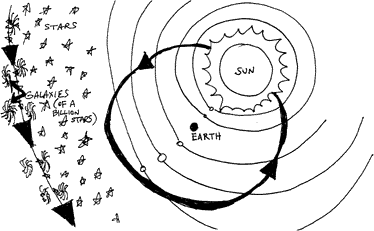
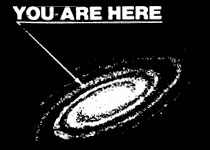
Only two galaxies other than the one we live in, can be seen with the unaided eye. Without a telescope those two "nearby" galaxies appear as faint dots in the sky, while over a billion more galaxies are out there, unseen. If you raise your fist to the sky at arm's length in almost any direction, your fist is covering the area in the sky where about a million galaxies exist in the depths of space and time. And each of those galaxies consists of about a billion stars. If Morris' view is correct then the "various essential services" that all those stars provide the earth must be stupendous indeed! How very "needy" the earth must be! Yet only professional astronomers and owners of high-powered telescopes ever get to see any of the "light" emanating from the many galaxies that exist "out there." And even the most diligent astronomer with the most powerful telescope only gets to see an infinitesimal portion of it during his lifetime. Thus, "the stars" could not possibly have been created "to light the earth" as Genesis says, or, to "provide various essential services for the earth and its inhabitants" as Morris says.

God's cosmic "interest" appears far more "spread out" than the Biblical account of creation suggests. Exactly why should God have busied Himself "specially creating" rings of matter around stars other than our Sun, or created planets circling stars other than our Sun? Why indeed? What "essential service" do they "provide the earth and its inhabitants?"

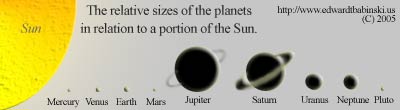
What "essential service" is being provided by the most distant planet in our solar system, Pluto, a planet that wasn't even detected until this century? Are there some "essential services" being provided by the eight massive objects (each about 100250 km in diameter) recently detected circling our sun in orbits beyond Neptune and Pluto? How many other bodies besides these move in secret, never "lighting" the earth, nor "providing various essential services to the earth and its inhabitants"? According to astronomers, most of the matter in the universe doesn't shine at all.

Surely, Morris must realize that long before him, Christians have struggled with questions of "How and Why God created objects that did not circle the earth and did not provide various essential services to the earth and its inhabitants." Though Morris displays little knowledge of such historic precedents.

For instance, in Galileo's day, the discovery of Jupiter's moons raised a ruckus amongst Biblical theologians. If Jupiter had but a single moon circling round her, that would mean that God had specially created a "lesser lamp" to "rule" Jupiter's night. Indeed, why would Jupiter be created with not one, but many "lamps" to light itself and to rule its night? Why would God in his "infinite wisdom" give such "preferential treatment" (i.e., not just one but "many lamps") to a planet that didn't even have any inhabitants?

Needless to say, the very idea of inhabitants like man being found elsewhere in the universe was deemed blasphemous, for the Bible says that God spent three out of six days specially creating all the life on earth, rather than creating life elsewhere in the cosmos, and, the Bible says that Eve was the mother of "all" living beings "created in God's image," so there couldn't be any more beings created in God's image existing on other planets.

Hence, theologians denounced the sight of "many moons" around Jupiter even though Galileo's telescope clearly showed they existed. Such objects were mere "illusions of the devil," created to "lead astray, if possible, even the elect."

The Planet Jupiter

On another note, consider this. Mercury, Venus, Mars, Jupiter and Saturn, were regarded by the ancients as "wandering stars" because, with the unaided eye, those bodies resembled starry bright objects, but did not move in a predictable nightly circle like all the other stars. These "wanderers" (from which we get the word "planet") each moved in it's own peculiar path across the sky. Like regular stars, "wandering stars" were believed to emit their own light, not merely reflected light from the sun. Even the moon was regarded as emitting its own light, since Genesis, chapter one, calls the sun and moon both literally, "lamps." (Calvin in his Commentary on Genesis, agreed that the moon shone with some light reflected from the sun, but he also stubbornly asserted that the moon "must...be a fiery body...it is also luminous.") The telescope, however, suggested that the moon and the planets might be more like the earth, large massive bodies, and not necessarily "fiery" ones.

But, "If the earth is a planet, and only one of several planets, it can not be that any great things have been done specially for it as the Christian doctrine teaches. If there are other planets, since God makes nothing in vain, they must be inhabited; but how can their inhabitants be descended from Adam? How can they trace their origin to Noah's ark? How can they have been redeemed by the Savior?"

I'll allow readers to sort out such thoughts amongst themselves.

E. T. BABINSKI

Center of the Universe

Excerpts from Zindler

Report from the Center of the Universe

by Frank R. Zindler

As I drove from Columbus to Cleveland that Wednesday evening I had no idea just how important I was. Little did I realize that the sun, moon, stars -- yea, verily, the farthest reaches of the heavens -- were revolving about li'l ol' me! Once a day, even.

It was only after arriving at the National Bible-Science Conference, convening at the Brookside Baptist Church in Seven Hills Ohio, that I discovered that the Pope's timing (but not, of course, his rhythm) had been all wrong. John Paul II had hardly finished "forgiving" Galileo -- indeed, the ink was hardly dry on the pardon -- when a gaggle of "creation scientists" assembled at the navel of the world for the purpose of recondemning not only Darwin but Galileo and Copernicus as well.

As this most unusual of "scientific" conferences amen-ed and hallelujah-ed its way through morning, afternoon, and evening sessions of the first day, it became apparent that the most dazzling star in the geocentricity constellation of the creationist firmament was one Dr. Gerardus D. Bouw, an astronomy Ph.D. from Case Institute of Technology, now teaching mathematics and computer science at Baldwin-Wallace College in Berea, Ohio. Although creationists generally reject Einsteinian physics (relativity in any form leads straight to moral laxity, you know), Bouw made adroit use of Einsteinian principles to "prove" the adequacy of the earth-centered universe. However, only four wicked evolutionists in the audience seemed to notice this moral defect in Bouw's non-Euclidean geometry.

But of course, the calculus was mostly there to confound the mentally sluggish. The real proofs were biblical after explaining that the Missouri Synod of the Lutheran Church had taught geocentricity in its astronomy texts right up into the 20's of the 20th Century, he quoted Joshua X.13:

And the sun stood still, and the moon stayed, until the people had avenged themselves upon their enemies. Is not this written in the book of Jasher? So the sun stood still in the midst of heaven, and hasted not to go down about a whole day."

After a virtuoso mixing of scientific sounding phrases and scholastic theological arguments, he clinched his case: "... if God cannot be taken literally when He writes of the rising of the sun, then how can one insist that He be taken literally when writing of the rising of the Son?"

How many of the creationists present were geocentrists, I do not know one Rev. Walter Lang, a Missouri-Synod Lutheran and Executive Director of the Bible Science Association (headquartered in Minneapolis) was quite sympathetic, and I was led to conclude that the Missouri Lutherans are bringing back the geocentric doctrine.

According to science-writer Robert Schadewald (along with Prof. Emmanuel Sillman, a zoologist from Duquesne University, Pittsburgh, Prof. John Patterson, a thermodynamicist from Iowa State University, and me, one of four heathens in the pews), five of the 18 speakers were known geocentrists. Just how fast "this old-time astronomy" is spreading among believers in that "old-time religion" I cannot guess But not a single creationist spoke against it, not even Duane T. Gish, the creationists' Lochinvar of the debate circuit. Although he had a lot of quibbles with the thesis of one Dr. Kaufmann (who thought Christians should be more exercise-conscious), Gish found nothing to complain of when geocentrists were speaking.

The silence of all creationists when goof centrists were speaking is quite puzzling. Does silence mean tacit acceptance? Embarrassment? Or is it a case of honor among thieves: if you don't expose me, I won't expose you.

Whatever the answer may be for the most of the Ptolemaic talks, I can say with assurance that embarrassment was the cause of everyone's silence when Marshall and Sandra Hall (authors of the widely distributed book, The Truth: God or Evolution?) got up together to give one talk. As the discourse bounced back and forth between husband and wife every minute or so, things began to unravel.

Clearly enough, they had explained that the heliocentric theory was a "Satanic counterfeit," and they told of traveling to the biblical plain of Gideon (where Joshua had commanded the sun and the moon to stand still) and receiving a revelation that the moon is the clue to it all.

Without telling us how long they played twenty-questions with god after receiving this clue, the Halls proceeded to prove that the sun goes around the earth Marshall had hardly launched into his "proof" before his train of thought became derailed He groped for words and stalled. He couldn't find a way to pass the ball to Sanka Soon he was weeping openly, announcing that god "any minute now" was going to give him the right words.

God not getting involved quickly enough, however, Sandra got back into the show and told that they had watched an eclipse of the sun in which the moon's "shadow" had moved the wrong way! (She never made it clear when she was talking about the moon's blackened image viewed against the sun, and when she was talking of the eclipse shadow moving across the earth's surface.)

Hope springing up eternal, she took two Styrofoam cups and tried to model the motions of the sun and moon during the eclipse. Marshall stopped crying and gave encouragement.

But alas! Within another minute both were hopelessly befuddled by the Satanic counterfeit. Not only could they not realize that when facing the sun their left hands had faced east, but that when fuming their backs to the sun (and the audience) their left hands were pointing west, they also seemed to be unaware that the pinhole cameras commonly used to view eclipses also reverse left and right. When their time ran out, they could only announce that they had given everybody the key with which to unlock the treasure chest of astronomical knowledge, and they implored those with the experience in the subject to go for it. But not even the Ph.D astronomer tried to bail them out. Not one of the Christian scientists present offered to "throw out the lifeline" to save the sinking savants. Not one of the Christian scientists present offered to "throw out the lifeline" to save the sinking savants.

FRANK ZINDLER

[This page is from another article by Frank Zindler, "Turtles All the Way Down," and tells of a debate that took place between creationists at the 1985 National Bible Science Convention.]


The Great Debate

by Frank Zindler

"A second poplin thing that creationists might look for is some kind of an instrument that will detect darkness. It is my conclusion, based on [scripture], that darkness is a positive thing."

- Prof. Richard Niessen, Christian Heritage College

"I have no problem with the "firmament" being firm. I have no problem if out at the end of the universe, billions of light years [out]. . . there's a solid shell out there. I have no problem with that at all, from either a physical or a theological standpoint."

- Prof. Gerardus Bouw, Baldwin-Wallace College

Throughout the three-day conference, one had a sense that everything was being drawn toward a point of final consummation: the great debate which was to be the grand finale of the whole BS-shebang. The purpose of the debate was to decide an issue which had never been debated by a major scientific society: Does the universe actually revolve around the earth, or does it only appear to do so? The actual thesis being debated was the following:

The geocentric model of the universe is a better model because (1) it is more faithful to the scriptures and (2) it better explains the observations.

The debate was actually a double-barreled affair: on each side was a theologian to debate the biblical aspects of the question and a scientist to deal with the less important aspect-reality. Serve as theologian for the geocentrists was Or. Gerardus Bouw, who holds a Ph.D. in astronomy (really!) from Case-Western Reserve University. The would-be heliocentrist theologian was a dour fellow, Prof. Richard Niessen from Christian Heritage College, who described himself as "loosely associated" with the Institute for Creation Research. As far as I could establish, Niessen was the only Gish-ite at the meeting, and he had come to challenge the BS Association in the relatively safe area of biblical one-upmanship.

Niessen tried valiantly to prove that the Bible allows the earth to move, but it was an impossible task. Bouw had little difficulty in proving that the Bible is geocentrist. Joshua, after all, had made the sun -- not the earth -- stand still. Since the Bible is also predicated upon the earth being flat, science writer Robert Schadewald tries to get a three-way debate going (both he and I were willing to defend the biblical position on the flat-earth question), but the creationists wouldn't bite. To say that the sun revolves around the earth is one thing, but to say the earth is flat is embarrassing even to many creationists!

The assembly was shocked by Niessen's call for creationists to devote more time to darkness research. It was his view that darkness is a thing in itself-not just the absence of light. In Genesis, after all, god is depicted separating the light from the dark-a prow case resembling the straining of black eyed peas out of tapioca pudding. Ergo, darkness is itself a thing. When I asked the two theologians about the "firmament," Niessen went against the Hebrew etymology of the term (a smithing term meaning something hammered out into thin sheets, as of copper) and claimed it means "an expanse." Bouw, however, believing the King James Version as well as "the autographs" to be totally inerrant, agreed that the firmament was firm. When asked about the supposed windows in the firmament, he thought they might be "hyperspace tubes."

"Geocentricity vs. Acentricity: that's the argument. Acentricity meaning there is no center whatsoever.... To me, this is a hellish nightmare. This is worse than evolution, as far as I'm concerned"

- Prof. James Hanson, Cleveland State University

"There were three systems [of the universe] about the year 1600-which is probably where this debate belongs."

- Francis Graham, University of Pittsburgh

Although the geocentrists won the theology debate, this was not true of the scientific debate. It seems that in all of creationdom there was not a single "creation scientist" capable of defending the double motion of the earth. Thus it fell to my fellow heretic, Prof. Emmanuel Sillman of Duquesne University, to recruit a theistic evolutionist (an ex-Roman Catholic turned Greek Orthodox, a University of Pittsburgh Astronomy Department doctoral candidate reamed Francis Graham) to exorcise the ghost of Ptolemy. Graham had never debates before in his life, but he was highly motivated to defend the honor of his science. What he may have lacked in experience, he makes up for in intelligence. Graham was bright.

The ghost of Ptolemy that Friday was residing in the body of James Hanson, a professor of computer science at Cleveland State University. His presentations were full of impressive claims ("I can easily derive an equation to show that . . ."), but precious little proof. Graham was ready. After rapidly restating the classical proofs of the motions of the earth, he tossed off -- almost as an afterthought -- the brilliant argument which was to receive no rebuttal from Hanson.

Graham crumbled Hanson's cracker with the observation that earthquakes sometimes cause a variation in the length of the day. In heliocentric terms, this means that the earthquake has altered the rate of the earth's rotation. In the geocentric model, however, it would be "the heavens" -- supposedly revolving around the earth -- which are speeded up or slowed down by the quake. "How does the information get from the earthquake all the way out to the distant galaxies . . . then back to the earth, much faster than the speed of light?" he asked. He never got an answer.

Graham proceeded to analyze the techniques of geocentrists (and creationists) in trying to prop up their "theories" with endless numbers of ad hoc hypotheses. In a clever variation on Wayne Frair's joke about "turtles all the way down," Graham quipped, "What holds up the theories of geocentrists? It's ad hoc hypotheses all the way down!"

FRANK ZINDLER

About the author

Formerly a professor of biology and geology, Frank R. Zindler is now a science writer. A member of the American Association for the Advancement of Science, the American Chemical Society, and the American Schools of Oriental Research, he is also co-chairperson of the Committee of Correspondence on Evolution Education and Director of the Central Ohio Chapter of American Atheists.

For information on how to obtain copies of Zindler's many other writings, including his articles and books, contact: Society of Separationists, P.O. Box 8457, Columbus, Ohio 43201-0457.

The Evils of Copernicanism

Forget about the "evils of Darwinism"

Some creationists say the initial blame lies with the "evils of Copernicanism!

"Historians readily acknowledge that the Copernican Revolution [i.e., the idea that 'the earth moves and turns'] spawned the bloody French and Bolshevic revolutions... set the stage for the ancient Greek dogma of evolution...led to Marxism and Communism...It is reported that Marx even acknowledged his indebtedness to Copernicus, without whom Marx believed that his ideas would not have gained much acceptance...It is thus a small step to total rejection of the Bible and the precepts of morality and law taught therein."

- Gerardus Bouw, Ph.D., "Why Geocentricity?" -- an article that was in press and due to appear in the Baptist Bulletin, circa Sept. 1985. Bouw is leader of the Association of Biblical Astronomy, a group of creationist Christians who teach geocentrism. He is also the author of Geocentricity, a book that argues for a literal understanding of the geocentric passages in Scripture.

"Those who assert that 'the earth moves and turns'...[are] motivated by 'a spirit of bitterness, contradiction, and faultfinding;' possessed by the devil, they aimed 'to pervert the order of nature.'"

- John Calvin, sermon no. 8 on 1st Corinthians, 677, cited in John Calvin: A Sixteenth Century Portrait by William J. Bouwsma (Oxford Univ. Press, 1988), A. 72

The Genesis Institute Selling Geocentrism

The Genesis Institute, founded by former Bible Science Association director, the Rev. Walter Lang, writes seeking member/subscribers and offering a list of creationist books for sale.

The GI mailing stresses the new interest in geocentrism, contrary to the research of Copernicus, Galileo, and several other astronomers.

"Right now we are promoting the book called Geocentricity, by Dr. Gerardus Bouw. We believe this is possibly the most in-depth study of the question so far produced. It is available from the Genesis Institute for $17 plus $2 for shipping and handling. There is also a video produced by Dr. Bouw back in 1990 that answers the questions brought up in connection with the debate of whether the Earth or space turn [sic]. This is $19.95 (+p&h)."

The Institute sells a number of books and articles and even Bibles.

Anyone interested can contact the Genesis Institute at 7232 Morgan Avenue South, Richland, MN 55423-2940.

"People gave ear to an upstart astrologer who strove to show that the earth revolves, not the heavens or the firmament, the sun and the moon. Whoever wishes to appear clever must devise some new system, which of all systems is of course the very best. This fool [or 'man'] wishes to reverse the entire science of astronomy; but sacred Scripture tells us that Joshua commanded the sun to stand still, and not the earth."

- Martin Luther, Table Talk

"The eyes are witnesses that the heavens revolve in the space of twenty-four hours. But certain men, either from the love of novelty, or to make a display of ingenuity, have concluded that the earth moves; and they maintain that neither the [stars] nor the sun revolves...Now, it is a want of honesty and decency to assert such notions publicly, and the example is pernicious. It is the part of a good mind to accept the truth as revealed by God and to acquiesce in it."

- Melanchthon, famous Protestant Reformer and one of Luther and Calvin's friends -- as cited on the Internet in Wayne Aiken's incredibly long and amusing collection of quotations, "Freethought Fortune Cookie".

"To assert that the earth revolves around the sun is as erroneous as to claim that Jesus Christ was not born of a virgin."

- Cardinal Bellarmine 1615, during the trial of Galileo (cited in Wayne Aiken's "Freethought Fortune Cookie".)

"The heavens revolve daily, and, immense as is their fabric, and inconceivable the rapidity of their revolutions, we experience no concussion -- no disturbance in the harmony of their motion. The sun, though varying its course every diurnal revolution, returns annually to the same point. The planets, in all their wandering, maintain their respective positions. How could the earth hang suspended in the air were it not upheld by God's hand? (Job 26:7) By what means could it [the earth] maintain itself unmoved, while the heavens above are in constant rapid motion, did not its Divine Maker fix and establish it? Accordingly the particle, ape, denoting emphasis, is introduced -- YEA, he hath established it."

- John Calvin, Commentary on the Book of Psalms, Psalm 93, verse 1, trans., James Anderson (Eerdman's, 1949), Vol. 4, p. 7

"I will give $1,000 to anyone who can prove to me that the earth moves."

- R. G. Elmendorf (1980), member of the Association of Biblical Astronomy, and of the Bible-Science Association (a group of young-earth creationists). Elmendorf also has a new book on "scientific geocentrism," titled, The Foucault Pendulum.

Yes, but how can you know for certain the Earth does not move, or, that the earth is only a couple thousand years old?

"The only way we can know for certain whether or not geocentricity is true would be to leave the universe, take a look around outside the universe, and then come back in to tell us what is really happening in that larger scope. Since God is infinitely greater than the universe, and so extends beyond the universe, what God says must present the ultimate case...

"God, in His Word, consistently teaches geocentricity."

- Gerardus Bouw, Ph.D., "why Geocentricity?" -- an article that was in press and due to appear in the Baptist Bulletin, circa Sept. 1985.

"I would not be a geocentrist if it were not for the Scriptures."

- Gerardus Bouw, Ph.D. (1984 Bible Science Conference)

"The only way we can determine the true age of the earth is for God to tell us what it is. And since He has told us, very plainly, in the Holy Scriptures that it is several thousand years in age, and no more, that ought to settle all basic questions of terrestrial chronology."

- Henry Morris, president of the Institute of Creation Research (cited in Wayne Aiken's "Freethought Fortune Cookie").

"I find every [Christian] sect, as far as reason will help them, make use of it gladly; and where it fails them, they cry out, it is a matter of [Biblical] faith, and above reason."

- John Locke

Biblical Astronomy

"Biblical Astronomy!"

The latest advance in "creation science!"

A view advocated by some modern day creationists. The earth lies at the center of the universe. The sun revolves around the earth. All the remaining planets revolve around the sun, while the stars and distant galaxies; revolve around the sun on a daily basis.

Biblical Astronomy

"Biblical astronomy" (as displayed in the figure) originated in the 16th century. Its most notable exponent was Tycho Brahe (a Danish astronomer). Today's "Biblical astronomers" still advocate Brahe's System.

By the 17th century Brahe's System seemed improbable to people like Bernard Le Bovier de Fontenelle, Secretary of the French Academy of Sciences, who wrote in one of his popular science books: "Tycho Brahe, who had fixed the Earth in the Center of the Universe, turned the Sun round the Earth, and the rest of the Planets round the Sun, because new discoveries in astronomy left no way to have the Planets turn round the Earth. But among so many great Planetary bodies how could you exempt the Earth alone from turning round the Sun? It certainly seems improper to make the Sun turn round the Earth, when all the Planets turn round the Sun. Though Brahe's System was invented to maintain the immobility of the Earth, yet it was very improbable. So we resolve to stick to Copernicus, whose Opinion was most Uniform and Probable."

"Walter van der Kamp, Bible believing geocentrist and author of De Labore Solis (self-published, Surrey, British Columbia, 1988, 172 pages) outlines the Tychonian model more precisely than previous literature. According to van der Kamp, the immobile nonrotating Earth is at the center of the Universe. The sun and moon go around it daily, and the planets (the Earth is not one) go around the sun. Centered on the sun and also whizzing around the Earth a little faster is a shell, or Stellatum, where all the stars, galaxies, and quasars are found, one-sixth of a light-year distant from us. No known object is further than this, and a few stars are slightly closer. Gravity, as we know it, does not exist.

"The book does not begin with this model which is not developed until after page 90. Instead, there is an historical and epistemological synopsis which tries to demonstrate that all astronomy since Copernicus is wrong. This essay is written in a vocabulary characteristic of philosophy texts but it misses the chance to capture and discuss the central angst of Mach and Einstein. Instead, it engages in cavalier sophistry.

"Van der Kamp's opus ends with an open letter to John Paul II, urging him not to abandon geocentrism and instead recondemn Galileo whose case was recently posthumously reviewed. The Holy Father's reply, if any, is not given."

- Francis G. Graham

"The heliocentric view as opposed to the old geocentric view is not simply a matter of 'perspective.' Once Newton came along with his laws of gravity, you couldexplain why planets move in ellipses, how the Moon moves around the Earth, and why apples fall to the ground, among other things. And, to satisfy parsimony, all these disparate phenomena have the same explanation and the same very simple laws of motion to obey. Blows Ptolemy [and his geocentric viewpoint -- with no explanation of how or why things followed the paths they did] out of the water."

- Rachel (3 months shy of a Ph.D. in astronomy)

Not satisfied, like "scientific creationists," with merely wanting "evidence against the theory of evolution" taught in schools, today's Christian geocentrists want "evidence against the theory of gravity" taught in schools.

E. T. BABINSKI

Since the 1970s a few devout Protestant and Catholic scholars with Ph.D.s in physics and astronomy have begun to argue in favor of geocentrism ("geo"=earth "centrism"= lies at the center). These devout Bible believers maintain that the earth does not go round the sun, but that the sun, planets, and all the stars go round the earth. In the United States there is a society that defends Bible-based geocentrism, called the Association for Biblical Astronomy (founded in 1971 under the name of "The Tychonian Society"). The Association for Biblical Astronomy publishes a journal and books, and is led by a young-earth creationist who has a doctorate in astronomy from Case-Western Reserve University, Dr. Gerardus Bouw. Outside the U.S., in France and Belgium, a Catholic group called Cercle Scientifique et Historique, includes some members who support geocentrism.

Such geocentrists are also young-earth creationists and, like their young-earth brethren, "Biblical astronomers" feel the need to "point out flaws" in modern scientific evidence in light of "what Scripture tells us." And, like their young-earth partners, who publish "critiques of scientific arguments for an old-earth," these "Biblical astronomers" have recently published a number of books that "critique scientific arguments for a moving earth." They hope to open the eyes of the modern scientific community to the God-given truth that the earth doesn't move, or only moves slightly in comparison with the rest of the planets and stars in the cosmos, most of which must fly around the earth on a daily basis at speeds faster than light!

If the success of young-earth creationists at mobilizing "Bible believers" is any indication of future trends, then the cry, "Let's teach geocentrism!" can't be far behind. All it takes is some dedicated "Biblical astronomers" traveling tirelessly around the country, holding seminars at church after church, employing all the fancy "scientific" sounding rhetoric at their disposal to lead their brethren to cry out against "those lying, Satanic, evil believers in evolution, in an ancient earth, and a decentralized moving earth!"

This is not to say that all young-earth creationists agree with the new "science" of "Biblical astronomy." Most apparently do not. In fact, the young-earth creationists at the Institute for Creation Research recently published a pamphlet repudiating geocentrism. (See the July 1994 Impact article by Gerald Aardsma, available from the ICR for a nominal fee.) But it will take more than just a pamphlet to stop "Biblical astronomy" from spreading."Biblical astronomers" have debated their young-earth brethren at a few "Bible Science conventions," neither side being able to convince the other. And, among "Bible believers," the scriptureverses supporting geocentrism provide formidable ammunition against mere "scientific" arguments to the contrary!

It's ironic but true, that Aardsma (the author of the ICR Impactarticle that defended ICR's heliocentric stance against encroaching geocentrist sentiments), agreed to leave ICR recently, because he no longer agreed with the lower range of ICR estimates for the age of the earth. Aardsma is absolutely convinced, via tree-ring data, that the earth cannot possibly be as young as 6,000 years. ICR still says the earth could be between 6,000 to 15,000 years old and ICR does not want to offend many of their supporters by "upping the lower limit" to 12,000 years as Aardsma has done.

That would offend too many folks who still believe that Bishop Ussher's "strictly Biblical" estimate of the age of the earth was the correct one, i.e., 6,000 years old.

E. T. BABINSKI

"40% of Americans surveyed believe that the sun moves around the earth. I remember reading the news story a few months ago. A much higher percentage knew the Earth moves around the Sun but weren't sure how long it took. Some of them guessed one day! Over 40% can't point out the Pacific Ocean on a blank map and over 50% don't believe in Darwin yet. So you see Copernicus is doing better than Darwin. 60% of the people understand Copernicus and only 50% understand Darwin, because he hasn't been around as long."

Robert Anton Wilson, interviewed in Boiled Boiled, Vol. 1, no. 1, 1989

Geocentrism

Geocentrism
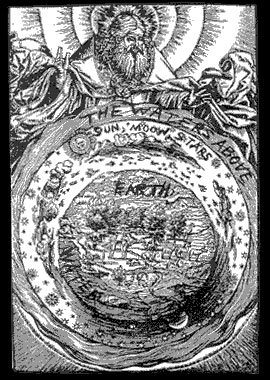
Frontpiece from Martin Luther's translation of the Bible
(Wittenberg, Germany: Hans Lufft, 1534)

Geocentrism

"Scripture simply says that the moon, the sun, and the stars were placed in the firmament of the heaven, below and above which heaven are the waters... It is likely that the stars are fastened to the firmament like globes of fire, to shed light at night... We Christians must be different from the philosophers in the way we think about the causes of things. And if some are beyond our comprehension like those before us concerning the waters above the heavens, we must believe them rather than wickedly deny them or presumptuously interpret them in conformity with our understanding."

- Martin Luther, Luther's Works. Vol. 1. Lectures on Genesis, ed. Janoslaw Pelikan, Concordia Pub. House, St. Louis, Missouri, 1958, pp. 30, 42, 43.

"God said, 'Let there be a firmament in the midst of the waters,' and God made the firmament, and separated the waters which were below the firmament from the waters which were above the firmament... Then God made the two great lights...(and) the stars also. And God set them in the firmament to light the earth."

- Genesis 1:7,16-17

"Praise the Lord!...Praise Him, sun and moon; Praise Him stars of light! Praise Him highest heavens, And the waters that are above the heavens!"

- Psalm 148:1,3-4